

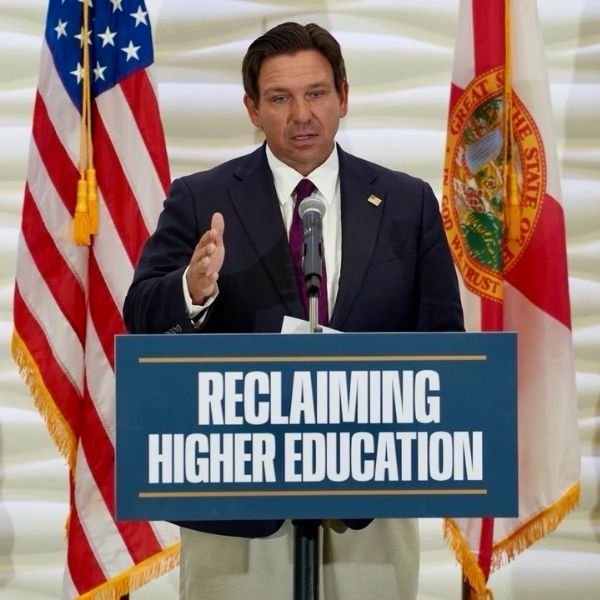
TALLAHASSEE, Fla. — Gov. Ron DeSantis has called on Florida’s public universities to stop hiring international employees under the federal H-1B visa program, a move that legal experts say is beyond state authority.
DeSantis said he directed the Florida Board of Governors to “pull the plug” on the use of H-1B visas, claiming universities were “importing foreign workers instead of hiring qualified Americans.” Nearly 400 foreign nationals currently work at Florida’s public universities through the program, according to the Orlando Sentinel.
“Universities across the country are importing foreign workers on H-1B visas instead of hiring Americans who are qualified and available,” DeSantis said. “We will not tolerate H-1B abuse in Florida institutions.”
However, legal scholars note that states cannot revoke or restrict federal visa programs, and U.S. Citizenship and Immigration Services prohibits firing workers based on immigration status.
The H-1B program allows U.S. employers to hire highly skilled foreign professionals for specialized positions when qualified American workers are unavailable. Across Florida, more than 7,200 people currently hold H-1B visas.
The debate comes as former President Donald Trump recently increased the H-1B visa fee from $215 to $100,000, a move expected to face legal challenges.
DeSantis claimed that jobs held by workers from China, Argentina, and Canada should instead go to Floridians, calling foreign hiring a form of “cheap labor.”
The University of Florida employs more than 150 staff members on H-1B visas, while the University of South Florida has 72 and Florida State University employs 69, according to federal data reviewed by the Tampa Bay Times.
Educators note that most H-1B workers fill roles in STEM departments, such as computer science, engineering, and physics — fields where U.S. universities rely heavily on international talent. In 2023, about 60% of PhD graduates in computer science were temporary visa holders, the Sentinel reported.
Donald Landry, interim president of the University of Florida, said the university would comply with the state’s review. “Occasionally, some bright light might be good enough for the faculty, and then we will try and retain the person into whom we’ve invested so much,” he said. “But that’s the exception that proves the rule.”















Leave a Reply