

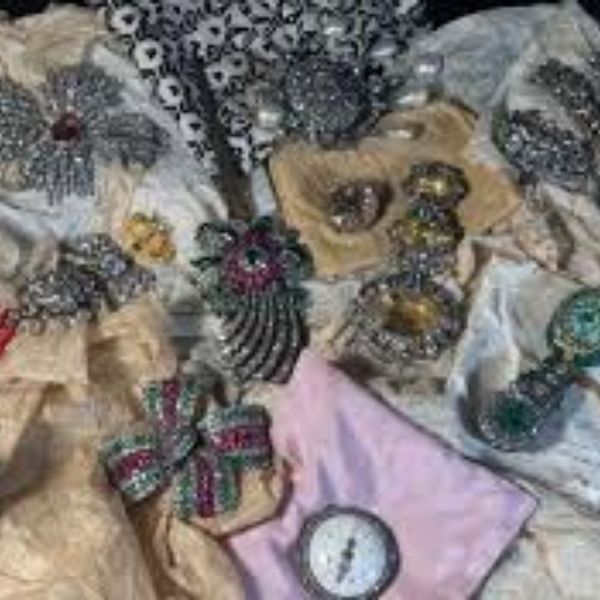
A century-old suitcase, long forgotten in a Canadian bank vault, has unveiled a priceless collection of Habsburg jewels, including a rare light-yellow diamond weighing just under one ounce. The suitcase originally belonged to Empress Zita, the last empress of Austria-Hungary, who carried it while fleeing war and revolution across Europe.
Zita, born into an Italian ducal family, married Archduke Karl of Austria in 1911 and became empress during the final years of the Habsburg monarchy. As German troops entered Belgium in 1940, she and her children escaped within hours, eventually settling in Quebec, Canada, so her younger children could pursue a French-language education.
Following Zita’s instructions, the suitcase remained unopened for generations, only revealed after 100 years. The contents include jeweled badges, hat pins in Hungarian national colors, bows set with old-cut diamonds and yellow sapphires, and the Florentine Diamond, a historically significant pale yellow gem once part of the Austrian crown jewels.
The Florentine Diamond had a storied past, displayed in Italian courts by the Medici family before joining the Habsburg collection. After World War I, the diamond disappeared from public records, sparking speculation about theft, recutting, or secret sale. Its rediscovery now allows historians and gemologists to study the stone’s cut, composition, and provenance, providing insights previously only hinted at in documents and portraits.
The Habsburg family plans to lend the collection for exhibition in a Canadian museum, honoring the country that sheltered them during wartime, before returning the pieces to secure storage. Austrian officials are reviewing ownership of the Florentine Diamond, a debate that could involve questions of heritage and royal property rights.
For historians, the suitcase confirms that objects once thought lost can survive turbulent centuries, revealing details about craftsmanship, usage, and the personal histories of royal families. For scientists, it provides a rare opportunity to test the diamond’s origins using modern technology. And for legal and ethical scholars, it raises questions about the public versus private stewardship of historically significant artifacts.
The rediscovered Habsburg jewels now stand as a testament to war, migration, and the preservation of cultural memory, transforming a private family treasure into a shared historical legacy.
This article has been carefully fact-checked by our editorial team to ensure accuracy and eliminate any misleading information. We are committed to maintaining the highest standards of integrity in our content.













Leave a Reply