

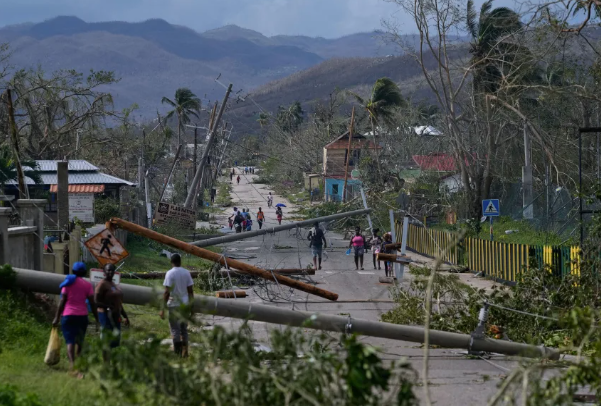
Rescue operations are underway across the Caribbean after Hurricane Melissa swept through as one of the most powerful Atlantic storms in over 150 years.
Torrential rain and fierce winds caused widespread devastation across Jamaica, Cuba and the Bahamas.
Melissa brushed Bermuda as a Category 1 storm from Thursday night into Friday, bringing quick bursts of strong wind and rain. The storm is expected to weaken and become post-tropical as it races south of Newfoundland into cooler Atlantic waters.
Ahead of the storm, Bermuda authorities closed the Causeway, which links the main island to St. David’s Island. Schools and ferry services were also suspended Friday out of an “abundance of caution,” said Bermuda’s national security minister Michael Weeks, according to Reuters.
The storm destroyed homes, caused severe flooding, triggered power outages and forced hundreds of thousands to evacuate across the region.
At least 50 people have died, Reuters reported, though the full toll may take days or weeks to be confirmed.
Emergency teams have started clearing roads to reach isolated communities, with international assistance now arriving.
The regional Disaster Assistance Response Team (DART), activated on October 29 by US Secretary of State Marco Rubio, has deployed and will be on the ground today.
Jamaica hardest hit
Jamaica suffered the worst impact. Melissa made landfall as a Category 5 hurricane with maximum sustained winds of 185 mph (295 kph).
“Complete and utter destruction” is how CNN’s Derek Van Dam described the streets of Black River, a coastal town hit especially hard.
Residents gathered around the Black River Bridge searching for food, water and information about missing loved ones. While the Jamaican Defense Forces have arrived by helicopter, desperation is growing. Many people are leaving with whatever belongings they can carry by car, motorbike or on foot.
Black River is facing devastation from a storm surge that topped 15 feet, overwhelming the southwestern town’s infrastructure.
Heat and humidity are making recovery efforts even more difficult. A makeshift camp shelters those who survived the storm, but nothing else remains standing.
“Everything is gone,” resident Britney Samms told CNN.
Looting has been reported. Van Dam described it as “a matter of survival.”
“What once was paradise is now hell on earth,” he said of the historic town, known in recent years for environmental tourism.
But even amid the devastation, there were signs of hope — laughter, hugs and emotional reunions as loved ones found each other.
In Montego Bay on Jamaica’s northwestern coast, 77-year-old Alfred Hines told Reuters how he escaped rising floodwaters. “At one stage, I see the water at my waist and (after) about 10 minutes’ time, I see it around my neck here and I make my escape,” he said.
Authorities recovered at least four bodies in St. Elizabeth Parish, a government source told CNN. The Jamaica Constabulary Force confirmed eight more deaths on Thursday in Westmoreland, Hanover and St. James.
Three more people died while preparing for the storm.
Around 25,000 tourists stayed in Jamaica during the hurricane, education minister Dana Morris Dixon said Tuesday.
As of Thursday, more than 13,000 residents remained in shelters and 72% of the island was without power, Jamaican officials reported.
The country’s infrastructure is “severely compromised,” said Desmond McKenzie, minister for local government and community development.
A CNN crew saw residents and military personnel pushing more than a dozen ambulances past debris in Santa Cruz as a medical convoy traveled to a badly hit coastal area.
Schools in the capital Kingston are expected to reopen Monday, Dixon said Thursday.
‘Extensive damage’ in Cuba
Cuba also suffered heavy damage after Melissa made landfall as a Category 3 storm on Wednesday. President Miguel Díaz-Canel said the country experienced “extensive damage.”
The storm caused flooding, mudslides, destruction of property and major infrastructure damage, particularly in eastern regions, where hundreds of rural communities were cut off.
As many as 140,000 people were isolated by rising rivers, according to the Red Cross. In Santiago province, at least 241 communities were cut off, Reuters reported.
More than 735,000 people were evacuated before the storm hit.
Cuba’s foreign ministry said it is in contact with the US State Department to clarify how the United States might help with recovery efforts.
Rubio said Thursday the US is “prepared to provide immediate humanitarian assistance” to the Cuban people, either directly or through local partners.
Under US law, private donations of food, medicine and other humanitarian goods to Cuba are allowed, as well as disaster relief efforts.
Cuban Deputy Foreign Minister Carlos Fernández de Cossío said, “We have been in contact with the State Department and are awaiting clarification on how and in what way they are willing to assist.”
Cuba is also receiving aid from China, Venezuela and the United Nations.
High death toll in Haiti
Haiti has reported the highest number of deaths so far, even though Melissa did not make direct landfall. At least 30 people have been killed, Reuters said. Twenty of the deaths — including 10 children — occurred in Petit-Goâve when a flooded river burst its banks.
Steven Guadard from Petit-Goâve said the storm wiped out his entire family.
“I had four children at home: a 1-month-old baby, a 7-year-old, an 8-year-old and another who was about to turn 4,” he told the Associated Press.
International response
The United Kingdom announced Wednesday it is deploying £2.5 million ($3.3 million) in emergency aid. The British government also arranged limited flights to help citizens leave Jamaica.
On Friday, the UK pledged an additional £5 million ($6.5 million).
China’s ambassador to Cuba shared a video on social media showing hundreds of boxes labeled “family kit” being shipped from a warehouse.








Leave a Reply