

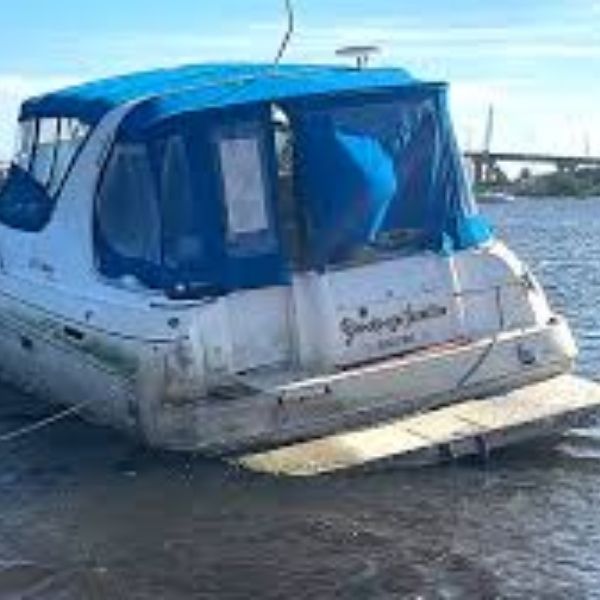
DAYTONA BEACH, Fla. — Florida officials say the number of derelict and abandoned boats in state waterways is rising faster than cleanup efforts can keep up, leaving hundreds of vessels scattered along the coast and inland waters.
The Florida Fish and Wildlife Conservation Commission (FWC) warns that these abandoned boats create navigation hazards, environmental risks, and neighborhood eyesores. Many vessels are submerged or partially sunken, making them hard to spot, especially at night. Storms often push boats ashore, further impacting waterfront communities.
Shonda Kennedy, with Orion Towing, Salvage & Marine and TowBoat U.S., said derelict vessels are a growing problem. “We are looking at a derelict vessel that has been left to die,” she said, pointing out a sunken 27-foot sailboat abandoned by its owner. Tracking down responsible owners is often difficult, especially when boats have changed hands multiple times or were purchased cheaply online.
At the start of 2025, Florida had more than 1,000 abandoned boats statewide. FWC has removed 478 vessels so far this year and maintains an interactive map to track known derelict boats. Salvage and towing costs can reach thousands of dollars, prompting some owners to abandon boats rather than repair them.
Leaving a derelict vessel is a first-degree misdemeanor in Florida, punishable by a $100 fine, while repeat offenders can face third-degree felony charges. In 2025 alone, the state spent over $9 million removing abandoned boats, prioritizing those posing environmental or navigational risks.
FWC urges boat owners who can no longer maintain their vessels to use the agency’s free Vessel Turn-In Program. Boats removed through the program are destroyed, helping prevent them from becoming future hazards.
Bradley Johnson, FWC public information officer, emphasized, “Now your vessels are in that derelict condition, and you may not have the means or the ability to get it off the water. The Turn-In Program is a safe way to prevent it from becoming the next hazard.”
This article has been carefully fact-checked by our editorial team to ensure accuracy and eliminate any misleading information. We are committed to maintaining the highest standards of integrity in our content.









Leave a Reply