

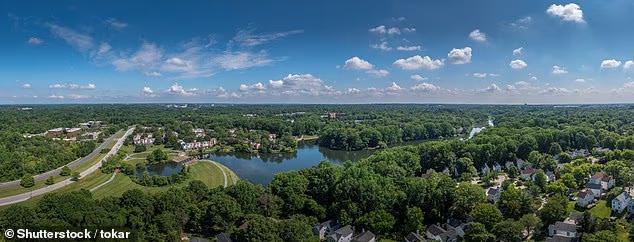
Maryland was shaken Monday evening by a rare earthquake within an ancient fault zone, reminding residents that seismic risks quietly persist along the U.S. East Coast.
The magnitude 2.5 quake struck around 5:17 p.m. ET, roughly 16 miles southwest of Baltimore. Residents in Riverside and Columbia reported feeling mild tremors, though no injuries or damage were reported.
While small quakes occur occasionally in Maryland, they’re seldom strong enough to be felt. This event took place in the Chesapeake Bay Seismic Zone, part of the broader Central Virginia Seismic Zone, which produces only two to three noticeable quakes each year.
A quake over magnitude 2.5 in this area is particularly unusual, as such events historically occur just once every decade.
Despite the surprise, geologist Rebecca Kavage Adams assured that the quake doesn’t signal a larger event.
“It’s a pretty normal occurrence,” Adams told WJZ. “The most you’re going to feel is maybe a little bit of motion of the building or the ground beneath your feet.”
Unlike California, which sits atop active tectonic boundaries, Maryland lies above a network of ancient fault lines—remnants from when the Atlantic Ocean began forming about 220 million years ago. These fractures can still release built-up pressure in the Earth’s crust, producing mild tremors.
Over the past 20 years, the mid-Atlantic region has experienced roughly a dozen notable quakes, including the magnitude 5.8 Mineral, Virginia, earthquake in August 2011, one of the largest ever recorded on the East Coast.
According to the U.S. Geological Survey (USGS), Monday’s quake was especially rare due to its proximity to the densely populated Washington–Baltimore Urban Corridor, home to nearly 10 million people.
“Since at least 1877, people in the urban corridor have felt small earthquakes,” the USGS noted. “They occur about once per decade, although some decades have none and the 1990s had three. None are known to have caused damage since the arrival of European colonists.”
While Monday’s tremor caused no harm, experts say it serves as a reminder that the East Coast’s ancient faults, though quiet, are far from extinct.









Leave a Reply