

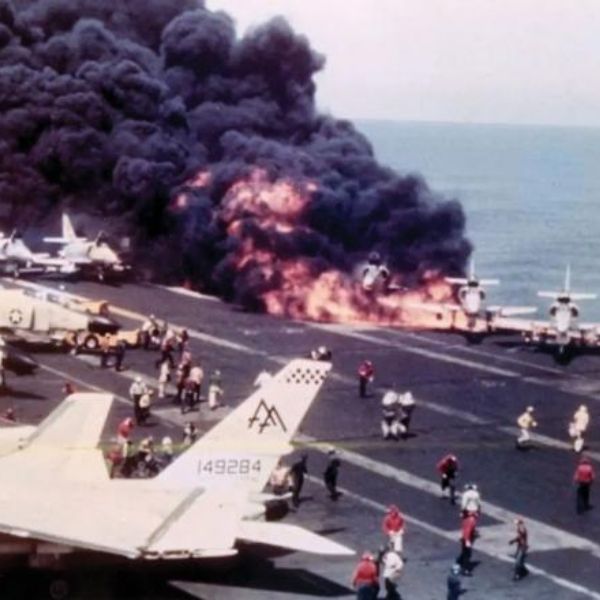
For nearly four decades, the USS Forrestal (CV-59) served as a cornerstone of U.S. naval power. But its legacy is forever marked by tragedy. On July 29, 1967, a series of explosions on its flight deck killed 134 sailors and injured dozens more, making it one of the deadliest non-combat accidents in Navy history.
The Beginning of the Disaster
The tragedy began when a rocket malfunctioned on the flight deck, rupturing a fuel tank and triggering a chain reaction of explosions. The initial blast caused a raging fire that spread rapidly, engulfing parked aircraft loaded with fuel and ordnance. Within minutes, multiple bombs detonated, sending shrapnel and flames across the deck.
Despite the chaos, sailors rushed to fight the inferno, many losing their lives in the attempt. Among the pilots who narrowly escaped was Lt. Cmdr. John McCain, whose aircraft was struck by the misfired rocket.
Heroism Amid Horror
As the flames raged, nearby destroyers USS Rupertus (DD-851) and USS George K. MacKenzie (DD-836) responded immediately, sending firefighting teams and equipment. The hospital ship USS Repose (AH-16) received the severely burned and wounded.
When the fire was finally extinguished, the toll was devastating —
-
134 sailors dead
-
161 injured
-
Over 20 aircraft destroyed
-
$70 million in damage
The human loss, however, far outweighed the material destruction. Some sailors leapt overboard to escape the flames, while others stayed behind to contain the fire — acts of courage that saved countless lives.
The Aftermath and Reforms
The U.S. Navy launched a full-scale investigation, led by Rear Adm. Forsyth Massey, which found that outdated safety procedures, poor training, and inadequate equipment contributed to the magnitude of the disaster.
As a result, the Navy completely overhauled its firefighting and damage control training, instituted stricter ordnance handling protocols, and improved emergency response systems. These reforms have since saved lives aboard every aircraft carrier that followed.
The Forrestal’s Later Years
Despite the extensive damage, the USS Forrestal was repaired and returned to service, completing missions in the Mediterranean, Middle East, and Gulf War. She was later converted into a training carrier (AVT-59) before being decommissioned in 1993.
Plans to preserve the carrier as a museum ultimately failed, and the ship was dismantled in 2015.
Today, a detailed model of the USS Forrestal is displayed at the National Museum of the U.S. Navy, serving as a solemn reminder of the sailors who gave their lives — and the lessons that reshaped naval safety forever.
This article has been carefully fact-checked by our editorial team to ensure accuracy and eliminate any misleading information. We are committed to maintaining the highest standards of integrity in our content.















Leave a Reply